



How to choose a dive computer that suits Sydney conditions


Most dive computer buying guides are written for warm, clear water. They assume you are stepping off a boat in the Coral Sea, not scrambling over rocks at Bare Island with 3 metres of visibility and a southerly picking up.
Sydney diving is good diving, but it has its own conditions. Choosing a dive computer here means thinking about those conditions first and features second.
Readability is the one thing you cannot compromise on
Visibility in Sydney changes between dives, between depths, and sometimes between breaths. A day at Shelly Beach might give you 8 to 10 metres. A winter dive at Ship Rock might give you half that.
In low visibility, your computer screen becomes the main way you track what is happening. If you have to squint, tilt, or pause to read it, it is the wrong screen for local conditions.
What to look for:
-
High-contrast display with large digits
-
Backlighting that is useful at depth, not just a dim glow
-
A layout where depth, time, and no-deco limit are immediately visible without scrolling or pressing buttons
Small, detailed screens can be fine in tropical water with 20 metres of visibility. In Sydney, they become a problem faster than most buyers expect.
Controls need to work with gloves on
Sydney water temperatures sit between roughly 15°C and 23°C depending on the season and depth. Most regular divers here wear gloves for at least part of the year, and many wear them year-round.
That changes how you interact with your computer. Touchscreens and small flush buttons are harder to use with neoprene on your hands. Larger, raised buttons with clear tactile feedback are easier to press without fumbling.
This matters because if adjusting a setting or checking a menu is awkward underwater, most divers just stop doing it. The features are still there; they just go unused.
Shore diving is harder on gear than boat diving
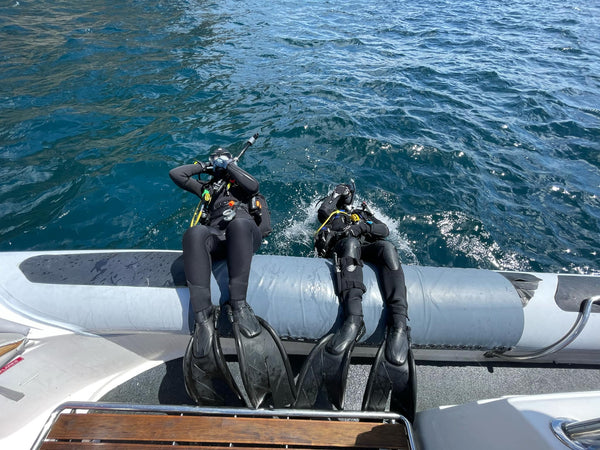
A large share of Sydney diving is shore-based. Sites like Bare Island, Kurnell, and Gordon’s Bay are walked into, not stepped off a platform into. That means:
-
Entries and exits over rocks, sand, or concrete ramps
-
Gear getting knocked, scraped, and salt-sprayed before the dive even starts
-
Setup in wind, sun, or rain rather than on a sheltered boat deck
A dive computer that lives in this environment needs a solid case, a secure strap or bungee mount, and a screen that handles scratches without becoming unreadable. Delicate units designed for resort diving can take a beating quickly.
Battery type matters more than it sounds
There are two main approaches to dive computer batteries:
|
Battery type |
How it works |
Best suited to |
|
User-replaceable |
Swap the battery yourself when it runs flat. Typically lasts 1 to 3 years depending on use. |
Divers who want simplicity and no charging routine. Good for spontaneous diving. |
|
Rechargeable |
Charge between dives or weekly. No battery swaps needed. |
Divers who are happy with a charging habit. Often found on higher-end units with colour screens. |
Neither option is clearly better. The question is how you dive. If you tend to grab your gear and go on a Saturday morning without much planning, a replaceable battery means the computer is always ready. If you are organised about charging and dive on a regular schedule, rechargeable works fine.
The worst outcome is a dead computer on the morning of a dive because the charger was left at home.
What you need versus what you can add later
First-time buyers often compare features lists and assume more is better. In practice, the features that matter on your first dive computer are the ones you will use on every dive.
Core features (use these every dive):
-
Depth and time display
-
No-decompression limit (NDL) tracking
-
Ascent rate warning
-
Surface interval tracking
-
Dive log
Features that matter later:
-
Air integration (connects to your tank to show remaining gas)
-
Nitrox and multi-gas support
-
Digital compass
-
Advanced dive planning modes
Air integration is useful, but it adds cost and is not something most newly certified divers need immediately. Nitrox capability becomes relevant if you go on to do an Enriched Air course. A digital compass is handy for navigation dives, but a good analogue compass on a retractor does the same job.
The practical approach is to buy a computer that covers the core functions well and has room to grow, rather than paying for features that will sit unused for the next 30 dives.
Why owning a computer changes how you dive
There is a real difference between using your own dive computer and rotating through rental units.
Rental computers vary. Different brands, different screen layouts, different button logic, different alert sounds. Every dive starts with a brief adjustment period while you relearn the interface. That is manageable early on, but it becomes more of a nuisance as your diving develops.
Your own computer builds familiarity. You learn exactly where to look for your NDL, how the ascent rate warning behaves, how the backlight works. That familiarity frees up attention underwater, which is worth more than any single feature.
It also gives you a consistent dive log. Your computer tracks your profiles across every dive, which is useful for monitoring patterns, planning progression, and meeting the logged-dive requirements for courses like Advanced Open Water or Rescue Diver.
A sensible place to start
For most Sydney divers buying their first computer, the priority list looks like this:
-
Readable screen in low visibility
-
Glove-friendly controls
-
Durable enough for shore diving
-
Reliable battery system
-
Core dive functions done well
-
Room to grow without immediate replacement
Specifications on a website only tell part of the story. Holding a computer, pressing the buttons, and looking at the screen layout in person makes a noticeable difference. Small things like digit size, button placement, and how information is grouped on the display tend to matter more than the feature list suggests.
The first dive computer is not about buying the best unit on the market. It is about buying the right one for the diving you are doing now, with enough headroom for what comes next.