



What to look for in a dive torch, and why Sydney divers carry one in daylight


You are certified, and you dive Sydney shore sites on weekends. The torches in front of you start at $65 and run past $2,000. Nothing on the box tells you which number matters.
A dive torch for Sydney shore diving needs enough output to light the inside of a ledge in daylight. It needs a beam tight enough to pick out one animal instead of the whole water column. It also needs a battery that outlasts two 45 minute dives. For most divers that means a mid-sized rechargeable torch of roughly 650 to 1,200 lumens with a narrow beam. Brightness is the easiest number to compare and the least useful one on its own.
Why do you need a dive torch in daylight?
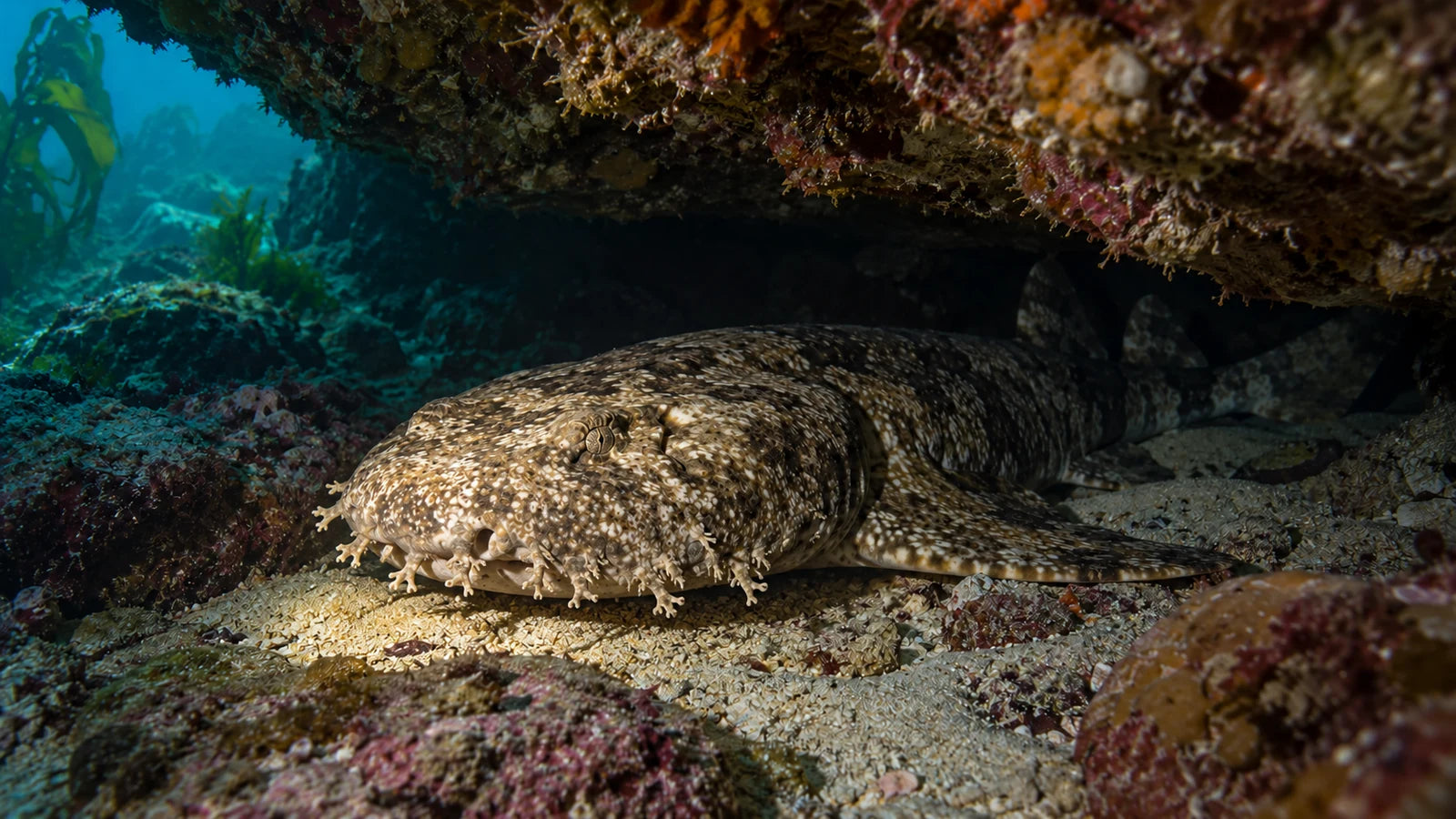
You need a dive torch in daylight because the animals you came to see sit in the dark parts of the reef. Sydney's shore sites are boulders, ledges, overhangs and swim-throughs, and that is where the marine life hides.
Wobbegongs and Port Jackson sharks rest under the ledges at Shelly Beach, and the Port Jacksons are most common from August to November. The Wall at Gordon's Bay holds both. West of the Kurnell entry, the swim-throughs hide cuttlefish. Our guide to Sydney shore diving covers those sites one by one.
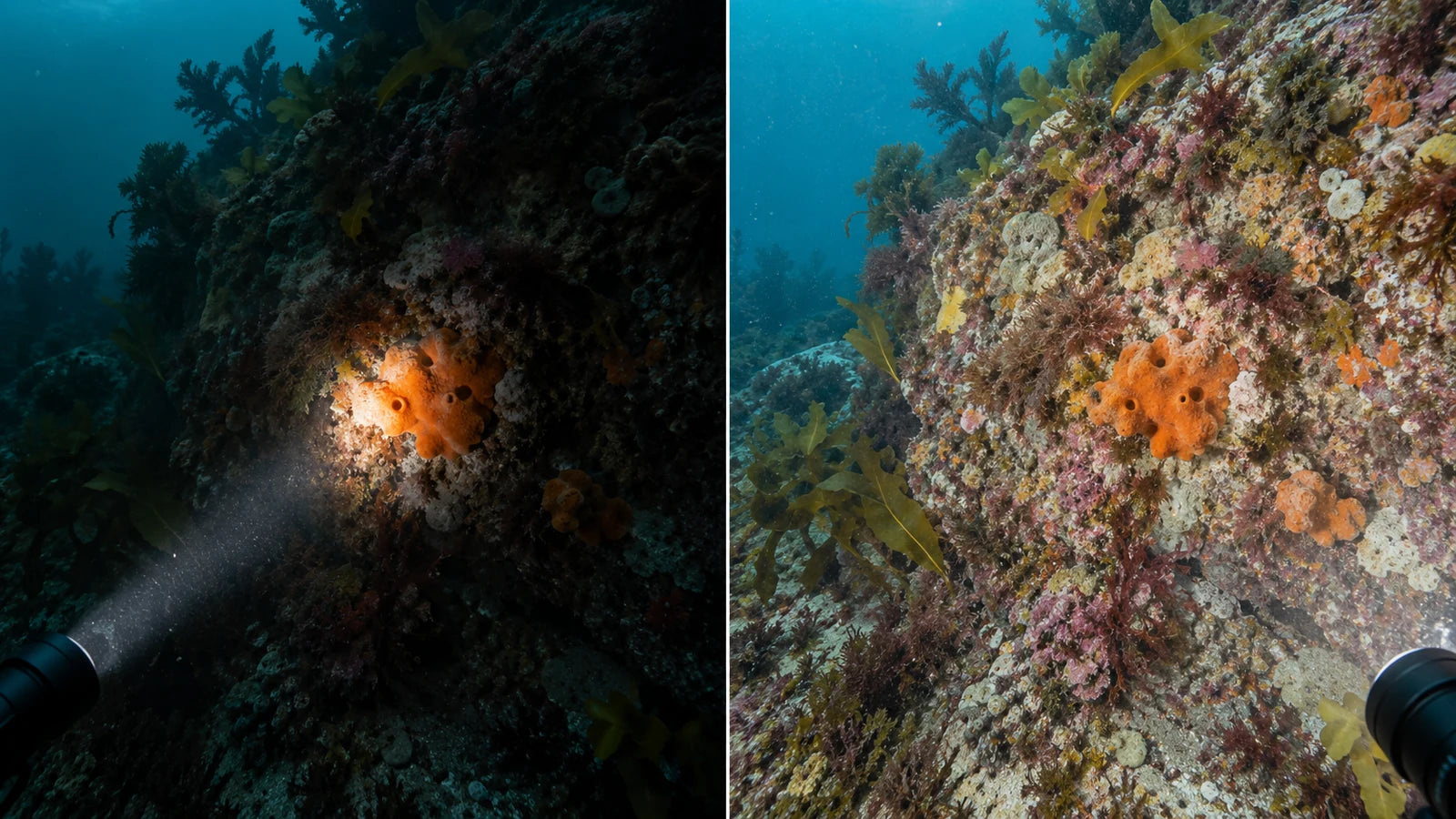
A torch does a second job in daylight, and that is colour. Water strips colour out as you go down, so a red animal reads as grey. An underwater torch puts the colour back. The site guide has divers work slowly along the kelp line at Kurnell, to bring out the orange-red of the weedy seadragons.
How many lumens do you need for a dive torch?
For most Sydney shore diving, between 650 and 1,200 lumens. A lumen is the total visible light a torch puts out, and every brand prints it biggest. Beam angle and colour temperature, meaning how warm or blue the light looks, matter more in the water.
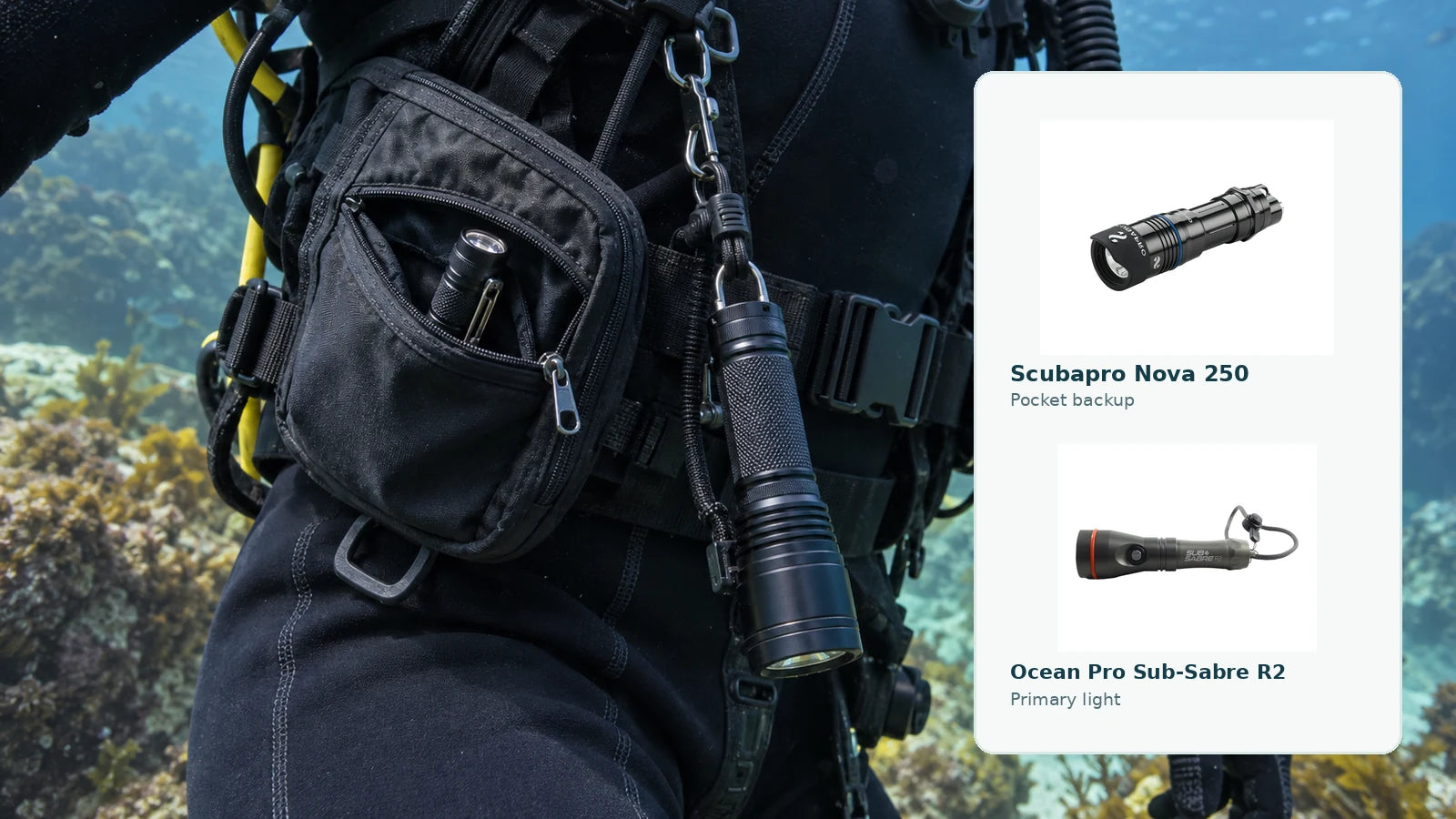
Split the range by job. Around 150 to 250 lumens is a pocket backup. From 650 to 1,200 lumens covers most Sydney day dives. From 3,000 to 4,000 lumens is for video, or for lighting a whole wreck compartment.
Lux is the more honest figure, because it is how much light lands on what you point at. A 250 lumen pocket light gives 2,700 lux at one metre. A 1,000 lumen dive light with a tight beam gives 21,000 lux. Four times the lumens, nearly eight times the light on the subject.
Wide beam or narrow beam?
Beam angle is how far the cone of light spreads. Published angles in this range run from 8 degrees to 110 degrees.
A narrow beam is roughly 16 degrees or under. It points into a ledge, picks one animal out of the kelp and gets your buddy's attention. A wide beam lights a whole scene, which is what photography and video need.
A narrow divers torch is the better first buy here, because most of the work is looking into dark holes. Many divers end up owning one of each.
One detail separates a dive torch from a bright household torch. Several listings name an extended light head shroud, a collar around the lens that stops the beam blinding the diver next to you.
Rechargeable or replaceable batteries?
Start with burn time, which is how long a diving torch runs on one charge. A rated 90 minutes at full power is two 45 minute Sydney dives with nothing spare. Most torches here hold a 50 per cent mode that stretches it, and a battery level indicator so you can plan the next dive on what is left.
Rechargeable lithium cells give the brightest output for the money, in sizes named 18650, 21700 and 26500. They need a charger and a power point.
A light that takes a common disposable cell keeps working on a weekend away with no power. One pocket torch runs on three AAA batteries. Another uses a single CR123 cell, with a shelf life of up to ten years. That is the point of a backup that sits in a BCD pocket all winter.
An O-ring is the rubber seal that keeps water out of the battery compartment, and it kills more torches than the LED does. Most of these lights carry a double seal and several ship with two spares. Many add an over-pressure valve, a one-way vent that lets battery gas escape.
Do you need a backup torch?
On a daylight shore dive, a second light is a convenience rather than a safety item. If the primary dies you finish the dive in daylight.
It stops being optional when the dive depends on the light. Inside a wreck, in a swim-through or after dark, a failed torch turns a good dive into a slow exit. Our guide to Sydney's shipwrecks makes the same point about the darker areas of a ship. A night dive light is the one case where carrying two is normal rather than cautious.
Be honest about the cheap end. A $65 pocket torch or a $110 CR123 light is a real backup. A $20 flashing marker is not. It marks where you are for twelve hours and lights nothing.
What size torch, and how do you carry it?
Four shapes, and the choice is mostly about what your hands are doing.
- A pocket torch on a wrist lanyard. One measures 41mm by 165mm at 195g, so it lives in a BCD pocket.
- A larger handheld torch. More output and more burn time, at the cost of bulk.
- A canister light with a Goodman handle, a strap across the back of the hand that leaves the fingers free. These top the range at $1,699. The adjustable focus version at $2,999 is a special order, six to eight weeks out.
- A video light on a camera tray, held by a YS clamp, the standard fitting for underwater camera arms. It mounts to the tray rather than to you.
Some dive computers carry a built-in light, which is nice to have rather than essential for recreational diving.
Which dive torch suits which diver?
Match the light to the diving you do most, not to the dive you might do once.
- Diving Sydney shore sites a few times a season. One mid-sized narrow beam torch. The $149 option gives 650 lumens at 16 degrees and 2.5 hours. The $239 option gives 1,200 lumens at 9 degrees, 90 minutes on high and 150 on low. In good visibility, the $110 pocket light is enough.
- Doing wrecks, and the occasional dive after dark. A brighter primary that survives two dives, plus a pocket light as the backup. The 1,800 lumen, 10 degree spot at $215 is the usual pick, with the $65 torch behind it.
- Shooting photos or video, or hunting crayfish. A wide beam video light for the camera: the $225 model gives 1,500 lumens at 100 degrees, plus a dimmer red mode. A cray torch is the opposite tool, narrow at 16 degrees for searching crevices.
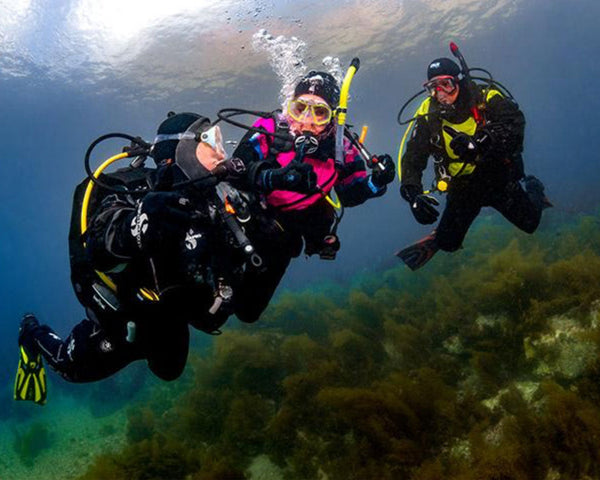
No single model is the best dive torch, and prices and stock move, so check both. If you are not certified yet, none of this is your problem: a Discover Scuba session supplies the full scuba set.
Before you spend on a second light, come out on a free guided shore dive. Every weekend a Divemaster runs one at a different Sydney site, free of charge and open water friendly. It is the cheapest way to see what a tight beam does at Shelly or Bare Island. Frog Dive's Gladesville counter is the other way to work through it. Everything in the torch and light range shares a collection with the knives and cutting tools, so most divers sort both in one visit. One habit is worth starting on the first dive: leave the torch on 50 per cent, and save full power for the ledge in front of you.
Frequently asked questions
How deep can a dive torch go?
That depends on the torch, and the figure sits on its own listing. Across the lights here the published ratings run from 50 metres to 150 metres. Depth rating belongs to the model, not to dive torches as a class.
Can you use a normal waterproof torch for diving?
A dive torch carries three things a household one does not. A stated depth rating, two seals instead of one, and a vent for battery gas. Surviving rain and surviving pressure are different jobs.
How do you look after a dive torch between dives?
Watch the seal rather than the bulb. Spares come in the box with several models, so keep them with the torch instead of in a drawer at home. Check the charge indicator the night before, not on the rock platform.
Do you need a torch for a Discover Scuba dive?
No. The gear for that session is supplied, so a light is not something to sort out first. Choosing one is a decision for after you certify.